Climate realism starts with the facts.
Climate realism explains why we are not making progress and what we have to do
if we really want to tackle climate change.
To understand climate change and the wider environmental harm, we need to begin with the facts. We need an honest assessment of what is working and what is not.
The challenges are significant: carbon levels in the atmosphere are still rising, a genuine energy transition has yet to begin, and global energy demand is expected to rise sharply. Renewables are not cheap, nuclear power is costly, and carbon offsets are often little more than modern indulgences. Some place their faith in technology or use offsets to ease their consciences, but this is wishful thinking.
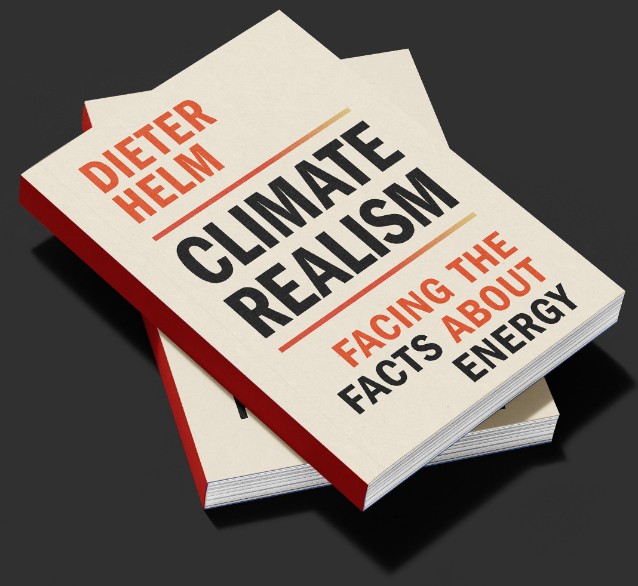
Climate Realism: Facing the Facts about Energy offers a radical reassessment of our current position. It argues that we must face the real cost of pollution we create and shows how to avoid wasting the years ahead.
Advance purchases are now available via Cambridge University Press and Amazon

Dieter Helm is the single most authoritative and impressive thinker on energy and the environment in Europe today. He is bracingly honest, intellectually fearless and morally compelling. It is impossible to think seriously about climate change, net zero and our politics without reading this brilliant book.
Michael Gove, former Secretary of State for Environment, Food and Rural Affairs (2017-2019)
As formidably well-informed as he is incisive, Dieter Helm understands — and explains — the nexus of economics, policy, technology and science better than anyone writing about climate issues anywhere in the world. Agree or disagree with his analysis, you cannot afford to ignore it.
Edward Lucas, former energy editor, The Economist
Climate realism is at times bracing. It is often uncomfortable. You might not agree with every sentence. But it will make you think. And thinking clearly is still the first step we need to take on our global warming journey. Reading this book is a very good use of precious time.
Chris Giles, Economics Commentator, Financial Times
Dieter Helm makes a persuasive case that the argument about climate change needs to change. Two camps – the optimists and the pessimists – have become entrenched but neither have the virtue which Helm recommends, which is realism. This is a bracing reminder that we need to confront the costs of transition and make sure that we enforce the principle that the polluter must pay.
Philip Collins, Editor, Prospect magazine
Dieter Helm has written a sweeping book that might be more aptly entitled, “Hard Truths and Hard Choices.” One may not agree with the author on every count. But skepticism about current policies ultimately gives rise to a clarion call that we recognize that more of the same will not regenerate the natural environment.
Paula Reynolds, NED, GE Vernova and National Grid
Dieter Helm wants us to challenge our settled views on what it will take to set the economy on a sustainable path. In Climate Realism he argues for testing policies that aim to reduce carbon consumption, which, inevitably, requires us all to pay more for our use of nature. Uncomfortable as this will be, the alternative is worse.
Professor Diane Coyle, Bennett Professor of Public Policy, University of Cambridge
In a world of pollyannas and cassandras, deniers and zealots, Dieter Helm is something rarer, but a lot more useful: a realist. Amid ferocious culture wars, this book is unusual. Helm commits what is heresy for those on one side of the debate: he accepts climate change is happening, is worrying and is serious. He also commits a heresy for the other side: renewables, he argues, have proven very costly and, so far, not terribly effective. This book might be depressing, but it is important – and maybe we need to face reality.
Tom Whipple, Science Writer, The Times
Dieter Helm has written the kind of book the climate debate badly needs: clear-eyed about the science, unsparing about policy failures, and refreshingly free of jargon. Some of his conclusions will be contested, and rightly so — that is how serious arguments advance. But the questions he forces us to confront, above all why thirty COPs have failed to curtail rising CO2 levels, cannot be ducked. Read it, argue with it, then think again.
Charles Godfray, Oxford Martin School, Oxford University
 Online lecture series. To open the lectures, click on the word “VIDEO”.
Related publications
Books
Helm, D. (2023). Legacy: How to build the sustainable economy. Cambridge University Press.
Helm, D. (2020). Net zero: How we stop causing climate change. William Collins.
Helm, D. (2019). Green and prosperous land: A blueprint for rescuing the British countryside. William Collins.
Helm, D. (2018). Burn out: The endgame for fossil fuels. Yale University Press.
Helm, D. (2015). Natural capital: Valuing the planet. Yale University Press.
Helm, D. (2015). The carbon crunch: How we’re getting climate change wrong—and how to fix it, revised edn. Yale University Press.
Helm, D. and Hepburn, C. (eds.) (2013). Nature in the balance: The economics of biodiversity. Oxford University Press.
Helm, D. and Hepburn, C. (eds.) (2013) (2009). The economics and politics of climate change. Oxford University Press.
Helm, D. (2007). The new energy paradigm. Oxford University Press.
Helm, D. (2004). Energy, the state, and the market: British energy policy since 1979 (revised edition). Oxford University Press.
Selected papers
Helm, D. (2003). “Assessment: Climate-change policy.” Oxford Review of Economic Policy, 19(3), 349–361. https://doi.org/10.1093/oxrep/19.3.349
Helm, D. (2012). The sustainable borders of the state. Oxford Review of Economic Policy, 27(4), 611–629.
Helm, D., Hepburn, C. and Ruta, G. (2013). “Trade, climate change and the political game theory of border carbon adjustments”, Oxford Review of Economic Policy, 28(2), 368–394.
Helm, D. (2025). “Net zero electricity: The UK 2035 target”, Oxford Review of Economic Policy.